Packing for yourself is one thing.
Packing for an entire family is a system.
Clothes, shoes, chargers, toiletries, children's essentials, backup outfits, snacks, entertainment, and "just in case" items can quickly turn a simple trip into a collection of bags nobody remembers packing.
The best luggage for family travel isn't necessarily one giant suitcase.
A better approach is to give each piece of luggage a clear role.
Quick Answer: What Luggage Is Best for Family Travel?
For many families, the most flexible setup combines:
-
Carry-on luggage for personal essentials
-
Checked luggage for shared clothing and larger items
-
A backpack or personal bag for items needed during the journey
-
A luggage set when the family regularly takes trips of different lengths
The exact combination depends on how many people are traveling, how old the children are, trip length, transportation, weather, and airline baggage policies.
The goal isn't simply to fit everything.
The goal is to make everything easy to find and easy to move.
Why One Large Suitcase Isn't Always the Best Family Packing Strategy
At first, one large checked suitcase can seem like the easiest solution.
Everyone's clothing goes inside. One suitcase gets checked. Problem solved.
Until someone needs a sweatshirt that is at the bottom.
Or the suitcase becomes difficult to lift.
Or the family separates for part of the journey.
Or an overnight delay means the bag you need isn't beside you.
Large checked luggage is useful, but family packing works better when important items are distributed intentionally.
Instead of thinking:
"Which suitcase can hold everything?"
Try thinking:
"Which bag should be responsible for what?"
That small change can make family trips much easier.
A Simple Family Luggage System
1. Personal Carry-On: Essentials for the Traveler
When practical, give each capable traveler responsibility for a carry-on suitcase or personal bag.
A personal carry-on can contain:
-
A change of clothes
-
Essential toiletries
-
Electronics
-
Chargers
-
Travel documents
-
Medication
-
A light layer
-
Personal comfort items
For children, parents can adjust this system according to age.
The principle is more important than the exact bag:
Keep the things someone may need first close to that person.
2. Checked Luggage: Shared Capacity
Use checked luggage for items that do not need to be accessed during transit.
That may include:
-
Additional outfits
-
Larger shoes
-
Full-size toiletries where permitted
-
Jackets
-
Family accessories
-
Extra packing organizers
-
Non-essential items
Instead of filling the checked suitcase randomly, assign zones or packing cubes to different family members.
This makes unpacking much easier when you arrive.
3. Personal Bag: The First 24 Hours
For air travel in particular, it can be useful to think of one bag as your first-24-hours bag.
Include the things your family would most want nearby if plans changed unexpectedly.
For example:
-
Identification and documents
-
Medication
-
Phones and chargers
-
One basic outfit
-
Children's immediate essentials
-
Valuable or important personal items
These should generally travel with you rather than inside checked luggage.
What Luggage Size Works for Different Family Trips?
There is no universal formula, but this framework can help.
| Family Trip | Luggage Setup to Consider |
| Weekend road trip | Carry-ons or a shared checked-size suitcase |
| 3–5 day family trip | Carry-ons + one shared checked bag |
| 5–7 day vacation | Combination of carry-ons and checked luggage |
| 7+ day vacation | Multiple suitcase sizes or luggage set |
| Multi-stop trip | Smaller, easier-to-move luggage |
| Winter family trip | More checked capacity for bulky clothing |
A warm-weather family vacation may require surprisingly little space.
A cold-weather trip with coats, sweaters, boots, and children's layers may require significantly more.
Choose luggage according to what you're packing, not only the number of nights.
Why a Luggage Set Can Work Well for Families
A luggage set is useful because family travel isn't always the same.
One weekend you may need only a carry-on.
The next trip might require checked luggage.
Later, multiple family members may need their own suitcases.
Having several luggage sizes allows you to build the right configuration for each trip rather than using the biggest suitcase every time.
This also gives families flexibility as children grow and begin managing their own belongings.
A suitcase that once carried shared family clothing may eventually become one person's travel bag.
Carry-On or Checked Luggage for Children?
Age matters.
Older children may be able to manage a small rolling suitcase themselves, while younger children usually require parents to handle more of the family's luggage.
Before assigning a child their own suitcase, ask three practical questions:
-
Can they roll it comfortably?
-
Can they keep track of it?
-
Can the adults still manage everything if the child becomes tired?
If the answer to the third question is no, your family may be traveling with too many separate pieces.
Family luggage should create independence—not create another task for the adults.
How to Pack Family Luggage So Everyone Can Find Their Things
Use Packing Zones
Instead of organizing one suitcase by item category only, consider organizing it by person.
For example:
Left side: Parent 1 Right side: Parent 2 Packing cube 1: Child 1 Packing cube 2: Child 2
The exact system doesn't matter as long as everyone understands it.
Keep One Outfit Together
For younger children especially, grouping complete outfits can reduce decision-making each morning.
A shirt, bottom, underwear, and socks can be packed together rather than separated into four different parts of the suitcase.
Separate Arrival Essentials
Think about what happens immediately after you arrive.
If your family reaches a hotel late at night, nobody wants to unpack three suitcases just to find pajamas and a toothbrush.
Put first-night essentials somewhere predictable and easy to reach.
Leave Some Empty Space
Family trips have a habit of producing additional belongings.
Souvenirs, gifts, children's activities, shopping, snacks, and miscellaneous items often need somewhere to go on the return journey.
Packing every suitcase completely full before departure gives you no flexibility later.
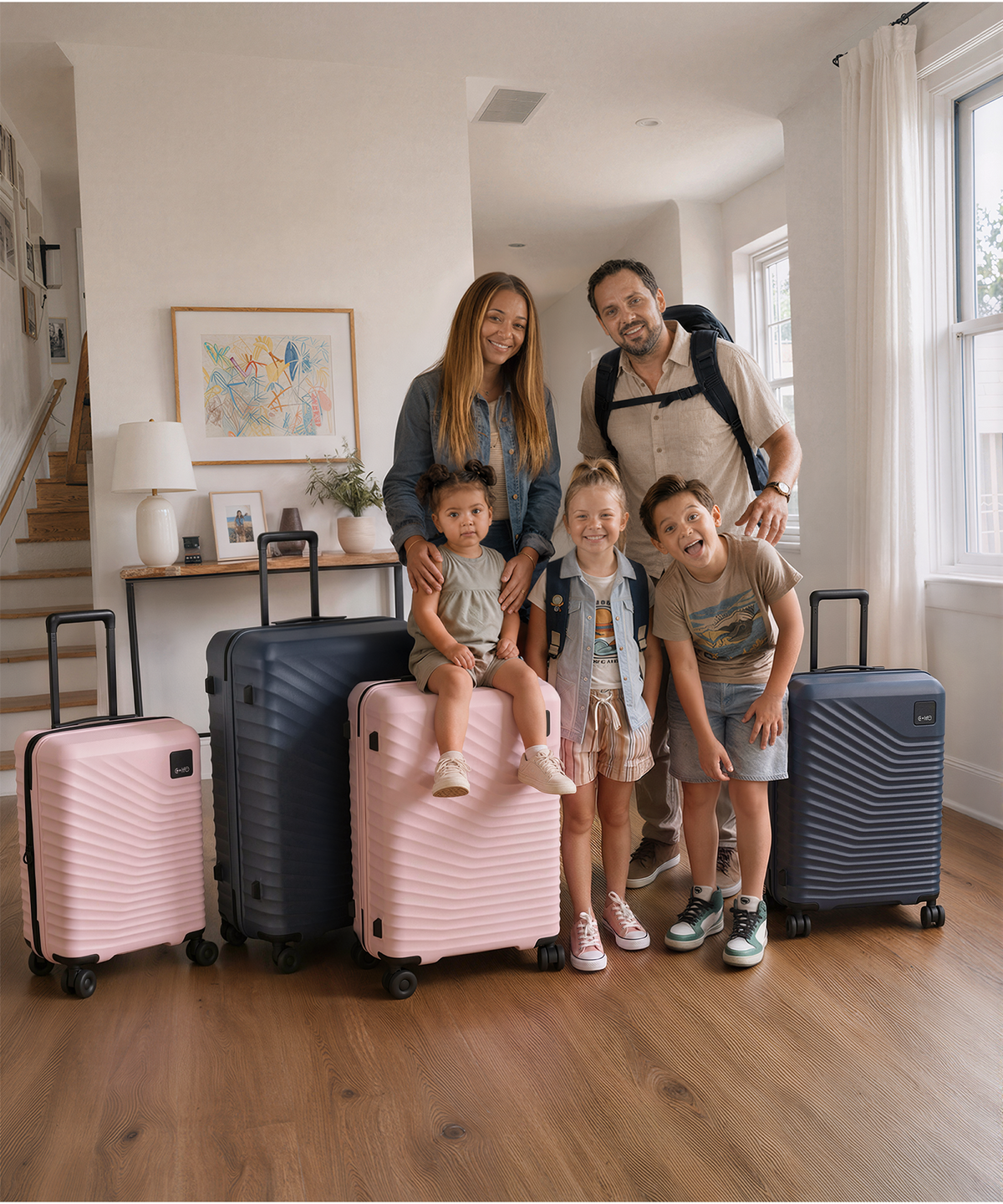
Should Family Luggage Match?
Matching luggage isn't necessary, but there are practical benefits to having a consistent luggage system.
Suitcases from the same collection may make it easier to recognize your family's bags together and choose different sizes while maintaining a similar packing experience.
If several family members have similar luggage, consider adding a recognizable luggage tag or other identifier.
The important thing is being able to identify each suitcase quickly.
What Features Matter in Family Travel Luggage?
When comparing family travel luggage, focus on usability.
Easy-Rolling Wheels
Parents rarely walk through an airport carrying only a suitcase.
There may also be backpacks, coats, children's items, food, documents, or a stroller involved.
Luggage that rolls smoothly becomes much more valuable when your attention is divided.
Comfortable Handles
Different adults may use the same suitcase throughout a trip.
A practical handle system makes handoffs easier.
Organized Interior Space
Separate compartments and packing organizers can help families keep multiple people's belongings from becoming one large pile.
Multiple Sizes
A combination of carry-on and checked luggage allows the family to adjust capacity from trip to trip.
Easy Identification
Color, luggage tags, and recognizable suitcase designs can help make baggage claim faster and less confusing.
Don't Pack for Every Possible Situation
One of the easiest ways to overpack for a family trip is to pack for hypothetical problems.
Three backup outfits.
Several pairs of shoes.
Extra toys.
Multiple jackets.
An entire medicine cabinet.
Some backups are sensible—especially when traveling with children—but every "just in case" item adds weight and complexity.
Before packing something extra, ask:
Could we reasonably manage without this if we needed to?
If the answer is yes, you may not need to bring it.
Family Travel Luggage FAQ
What size suitcase is best for a family of four?
There is no single ideal size. Many families find a combination of carry-on luggage and one or more checked suitcases easier to manage than relying exclusively on one very large suitcase.
Is a luggage set good for a family?
Yes. A luggage set gives families multiple suitcase sizes that can be combined differently depending on trip length and the number of travelers.
Should every family member have a suitcase?
Not necessarily. Older children may benefit from having their own suitcase, while younger children often travel more easily when parents consolidate their belongings.
Is carry-on luggage enough for a family vacation?
It can be for short trips or highly efficient packers. Longer trips, winter clothing, young children, and special equipment often make checked luggage useful.
What should go in carry-on luggage instead of checked luggage?
Keep documents, important medication, valuables, electronics, and essentials you may need during the journey with you. Always review airline and security rules before packing.
Build a Luggage System, Not Just a Packing List
The easiest family trips aren't necessarily the ones where you bring the least.
They're the ones where everyone knows where things are and which bag does what.
Use carry-on luggage for accessible essentials, checked luggage for shared capacity, and personal bags for the things your family needs during the journey.
For families that travel regularly, a luggage set can make that system even more flexible.
Because the best family luggage doesn't just carry more.
It helps your family travel with less friction.
Explore Coolife Luggage Sets → Luggage Sets Collection
Shop Carry-On Luggage →Carry-On Collection
Explore Checked Luggage →Checked Collection